
Once outside of the bank’s walls I fled back to Hooverville, mindless of the stones that cut my feet as I stepped on them or the pedestrians and motorcars that flowed by. Fled away to my little lean-to in Hooverville like a wounded animal to its den. Appropriate I guess, because in physically lowering myself and accepting that cat food I spiritually lowered myself and accepted that I was no better than a beast. A worthless, unloved stray. Once in my little shelter I curled up into a ball and sobbed and sobbed like I hadn’t since I was but half my age. No-one could have been more wretched than I at that moment, and as the tears flowed from my eyes, so to did the energy flow from my body and I fell into an at first fitful sleep, that, with my exhaustion and lack of sleep the previous night, turned deep.
It must have been around two in the afternoon when I awoke. Ironically, as hateful as the morning’s meal had been, it was the most nutritious thing I had had in months, and I did not feel the hunger gnawing at me quite as badly as I usually would have at this time of day as I anxiously awaited the good people with their thin stew to come and show us their largesse. If anything, the food and the sleep left me feeling better than I had in weeks, if not months, and my mind felt clearer, less fevered, as I departed my little home and started walking out of the camp, heading to the streets.
Gazing at myself in a shop window, I could see how red my eyes looked, all puffy and raw, as were the edges of my nostrils from where snot had run from them in my misery and been carelessly wiped on the back of my coarse sleeve many times over. A new, or rather reclaimed, clarity returned as I gazed back at myself, a realization of how lost I had become in my hunger and misery. The pains of hunger will do that to you over time. The hunger becomes like an obsession and all you can think about is how hungry you are, how desperate for food, so that what once you would have refused, now becomes a tantalizing morsel, a banquet. And as the hunger gets worse, sleep no longer welcomes you into its embrace, or if it does, it is fitful and easily lost as the hunger pangs gnaw away at your insides. And as the lack of sleep gets worse, the mind becomes sluggish, your ability to stay healthy drifts away, and you spiral downwards. The cat food and cream, and the sleep that followed had pulled me out of that spiral. How wretched that the greatest kindness shown to me these last few weeks had been a rich man’s cruelty.
I’m not sure how long I stood gazing into the window, lost in these thought, but it was long enough for a cop to roughly shove me and tell me to be on my way. That’s one of the other terrible things about my damnation. Policemen had long been my heroes, but that had been when I had been a young girl, in clean clothes and a washed face. Now, as a destitute waif, unwashed and in dirty clothing, I was no longer worthy of their protection and kindness. As one of the beggars that now blighted the street, had taken over a large portion of the park, I was now less than human in their eyes. Like the stray beast that I had become in offering myself to Mr. Dervish. I moved on, lest he arrest me for loitering or resisting him. Cops who had once protected people like me, now protected the good people – the good people with jobs and homes and washed faces – from the likes of me.
But though I may no longer have worth to the world, I would, I vowed, at least hold back the slippage into degradation to whatever degree I could. Returning to Hooverville and finding a pathway down to the water’s edge of the lake in the heart of the park, I knelt down and for the first time in a long while washed my face and hands, the water’s coldness like a waking jolt that further focused my mind. Feeling a little cleaner I washed my hair, running my fingers through it to undo some of the many tangles that had taken hold. It would mean risking a terrible chill if I were unable to find a means to dry it soon, but I did not mind, and luck was with me for I found an old blanket, discarded because of the many holes in it, that seemed clean enough to use as a towel, especially when compared with the dirt and grime I had removed.
Later that afternoon, as I stood in line for the meal handout, I felt better than I had in ages.
Better because I had a plan.
A plan as bold and brash and stupid as my one to become a pet.
But an oh so much better plan.
“MMMMMMMRRRRROOOOOOOOWWWWWWWWLLLLLLL!!!!!”
I could picture Mr. Dervish’s reaction as the noise tore through his peace the following morning. A noise that could best be described as a howl like no beast or human would make. “MMMMMMRRROOOWWWLLLL!!!” it repeated over and over, loud, grating, filled with venom and sorrow.
With an intensity in my glare, I watched as he appear, his face turning from confusion to anger, through the doors that opened out onto his balcony. Saw him return my glare as he caught sight of the source of this outrage, standing there in the middle of his hall, crying out with all her might, “MMMMMRRRROOOOWWWWWWWLLLLLL!!!”. Twinkle had had the temerity to return.
One of the security guards approached and reached for my arm, ready to drag my out, but with a loud hiss I pulled away and struck out, fingers extended like claws, catching him on the nose and, though not drawing blood, leaving a distinct scratch.
The bank employees and customers seemed to decide it was best to keep back from this young girl acting so strangely, like a wild animal, a dangerous gleam in her eyes, and I heard someone calling for the police to be alerted. With a voice filled with fury, Mr. Dervish called down for the security guards to apprehend me and throw me back out on the street, and, despite more clawing, and desperate, vicious kicks as one of them lifted me from behind in a bear hug and carried me to the doors, the guards succeeded in but a short moment in doing his bidding.
No sooner had they returned from this errand, but that I strode, with a pride I had no right to wear, back into the bank. “MMMMRRRROOOOWWWWLLL!!!” I cried out again with all the force I could muster.
Mr. Dervish’s orders were harsh and a moment later, I was again ejected, tossed roughly outside, to roll down the steps that lead up to the bank’s grand entrance.
For a moment or two I lay there, vaguely aware of the early morning crowd of workers and customers out and about in the street looking on, and, if not part of the group inside the bank, no doubt wondering what the ruckus was all about. Rolling onto my back, I fixed my gaze up the stairs and caught sight of some of those inside the bank peering nervously out. Their contempt for ‘Twinkle’ from yesterday, now replaced with a nervous unease, and I started to giggle, almost manically. It was not hysteria or some madness overcoming me. No, if anything it was a necessary release as determination returned after the disorientation and pain of my duel ejections receded. And after that moment or two, I stood on giddy legs, and walked back up the stairs.
This time I had no hope of entering. Both security guards stood there menacingly, but I could see Mr. Dervish up on his balcony, a murderous look on his face. With a gleam in my eye, I threw back my head, and loudly cried out, “MMMMMRRRROOOOWWWWLLLL!!!” past the guards at him.
A noise came from behind, a commotion as people were told to move aside and move along. Looking over my shoulder, I saw through the outside spectators of this strange event come three police officers, burly of build and clearly not in the mood for any nonsense. Looking up at the scene before them, it was very clear I was the source of this public disturbance.
Striding up the stairs the three police officers confronted me, their leader, the very sergeant who had ejected me from the bench little over a day before demanded I explain myself, while the other two gripped my arms, ready to drag my off to the cells.
In my mind’s eye, I imagined Mr. Dervish’s glare taking on a sheen of triumph as he saw this wretched child confronted by the officers of the law, looking so small as she stood encircled by the policemen and his security guards. No doubt he would be sure to make sure charges were pressed for her public disorder, and have steps taken to ensure she was never allowed near the bank again, if only by seeing to it that she be tossed into a prison somewhere.
As the police officers got ready to drag me away, I looked the sergeant straight in the face. “Excuse me, sergeant, sir,” I began politely, “but did you ever know…” and I named my father. The sergeant paused and though I doubted he had known the name (though the last name was common enough that he would surely have known officers with it), I continued. “He was a large man, like yourself, but maybe half a head taller, and he had red hair. He came over on the boat from Ireland about twenty-five years ago and worked in the __ precinct until a few years ago. Un-until September 1929 when he was killed in the line of duty by a bootlegger.” And now the police officers looked at me, looked at me anew, and the grip on my arms softened.
Through trembling lips I continued, my voice softer, quieter, more like the child I still was. “H-he was my daddy and I loved him. A-and mommy loved him, and they loved each other. A-and we were so happy and then he died a-and mommy took to drinking a-and I ran away when one of her men-friends tried to touch me in a bad place a-and I’ve, I’ve been living on the streets for months, living i-in Hooverville and I feel so scared and lost and hungry.”
And now the police officers looked at me no longer with the hostility with which they had started. And though it is unlikely they knew my daddy, they no longer looked at me as a trouble-making beggar, a non-person, but as a person. They looked at me and maybe saw the children of officers they knew, maybe their own children, and recognized how little it would take for those same children to find themselves, through no fault of their own, in my own dire straits.
“So what is all this about?” asked the sergeant, his voice not unkindly.
A few minutes later, I was again standing in the middle of the bank’s grand hall, staring up at Mr. Dervish, the three officers having pushed the guards aside and escorted me in. Like protectors. The sergeant called up to him, “Mr. Dervish, sir, is it true that this young, this very young, girl offered herself to you as a pet and you invited her to come back yesterday with a suggestion that you might be willing to take her up on the offer, sir? In fact, is it the case that you gave her a pet name – Twinkle – and money to buy a collar with that name on it?”
I was not the only witness to Mr. Dervish’s crimson face, not the only one to see him beset by both rage and embarrassment. All around the hall stood his bank’s employees and customers. Those same people who had looked at me with scorn yesterday, now were looking up at Mr. Dervish with a new perspective on his actions. Mr. Dervish blustered, trying to paint his actions with the veneer of kindness, a less than easy act as people remembered the collar, remembered the cat food, remembered the mocking.
“He told me,” I loudly proclaimed to the crowd, now joined by the curious who filled the doorway, “that if I returned today, and every subsequent day at the same time there would be food for me. And cream, though perhaps that should just be an occasional treat and milk should be the staple.” I let a silence fill the space, lightly punctured by the whispers and murmurs of the crowd. “That’s why I was caterwauling when no food was presented. As he had instructed me to put this bell on the collar and purr when I received the food I assumed he wanted me to wail like a kitty awaiting her mealtime. Perhaps that was the problem. After all, he had instructed me to also had a loop put on the collar so that he could lead me around on a leash. Was that why you were so angry with me, Mr. Dervish? Did you want me to howl like a hungry puppy rather than wail like a hungry kitty?” I took a vicious delight in seeing his face turn ever more crimson at this. “Was it my fault? Should I had asked what sort of pet you wanted me to be when you had me kneel down in front of you with my hands behind my back while you stood over me and fed me candy?”
“Do you often offer young girls treats in exchange for letting you put a leash on them, Mr. Dervish?” asked the police sergeant, a dark frown on his face.
“W-what do you mean?” exploded Mr. Dervish, his anger overcoming his embarrassment, “She came to me! She offered herself to me! It was her idea for her to be my pet! It’s all her fault all this happened, not mine!”
“So this young girl,” responded the police officer with an icy calm, “this…child…this child who found herself on the street through no fault of her own, this child who’s father died serving the good people of this city, this child who came to you with an, aye, strange offer, is to blame for you acting in the manner you did?” the officer’s question trailed off with a certain cold contempt. At some point he had put his hands on my shoulders, like a knight ready to protect his charge.
Mr. Dervish could no doubt hear the challenge in the police sergeant’s tone and see the look in the eyes of the crowd that filled the hall. He hesitated, trying to find a suitable defense for his actions, but was saved or condemn by another voice. My own. “Hey, um, hey, I just want the meal I was promised.” All eyes turned to me and I smiled the most perky smile I could as all went so quiet you could have heard a pin drop. Even the murmurs and whispers stopped. I looked up at him and in the most chipper voice I could manage called up, “Twinkle is hungry, Mr. Dervish!”
Grasping at this lifeline, he called out to his secretary to get me food and a drink, and not two minutes later I was presented with a hearty meat sandwich and glass of milk. It looked so delicious, so tempting, I desperately wanted to take it and have my first real meal in months.
But that would let Mr. Dervish be the benefactor. The kind man who fed the poor waif who came to him with such a strange offer. “What’s this?” I asked imperiously. “This! This is not pet food. Where is the Spratt’s cat food? Why would you feed a sandwich to a stray? And this?” I indicated the glass of milk, “Why would you give a kitty milk in a glass rather than a bowl?” I put my finger in the glass, and then licked them like a cat having no other way to reach the liquid. I paused, aware that the crowd were all staring at my strange demand. “I was promised a bowl of the finest cat food and a drink to go with it every day as long as I presented myself at the bank at 8:45am. That’s what you promised me, Mr. Dervish. You even said you might one day put the collar around my neck and adopt me as a pet.”
I looked around at the crowd, and now it was their turn to lower their eyes downwards or away in shame as I berated them with vicious hostility in my tone. “What? You think I’m ill in the head or something? You heard Mr. Dervish yesterday, heard the offer he made me and the scorn in his voice. And, oh yes, it was the same scorn in your eyes, was it not. Scorn for the wayward girl who would trade her humanity for some food and shelter.” I was breathing heavier now, an anger in my breast, “Well by all means feel that scorn, feel that superiority. If it means I can make it through another day, another week, I’ll take the cat food and the scorn. But please. Oh, please don’t pretend this is a kindness. That Mr. Dervish acted out of goodness. That you didn’t look down on me and embrace his cruelty. So, come now, let little Twinkle eat, eat the cat food from a dish on the floor like the beast she is. Let her come and beg each morning. And let all of you feel superior to those of us who have fallen to misfortune. If it means I can have food in my belly and at least a chance of surviving ’til better times return, then I’ll be Twinkle, I’ll be a wretched stray beast. I’ll trade away a piece of my humanity for it.” I paused, feeling alive like I hadn’t for months, if not years. As I called them out on their behavior, I felt a sense of worth I had thought forever lost. “Food for a portion of my humanity. What did all of you good people get when you traded your humanity away?” And to that they had no answer. In their comfortable existences they had stood by while their fellows had struggled and fallen from society’s graces. Indeed, with the bank taking over repossessed properties they had profited from their fellow Americans’ misery. They had closed their eyes to the poor, and, their souls polluted, refused to look after orphans and widows in distress.
A tension filled the air, a tension broken by the police sergeant. “Well you heard the young miss, an agreement was offered for her to be provided cat food and milk each morning if she presents herself at the bank. A meal for her to enjoy here, from a bowl, in the center of this hall.” Better understanding me and my position, the police sergeant called up, “Mr. Dervish, sir, I assume there was some confusion this morning, but are you happy to keep to that agreement, sir? If so, myself and my colleagues can be on our way. Otherwise, sir, we’ll need to interview you and some of the other bank employees. To better understand what’s going on, you understand, sir. Make sure nothing untoward was going on with an underage child, as it were.” Mr. Dervish glared down at me, but knew he was beaten. Giving assurances that he would indeed honor the agreement going forward and thanking the officers for their assistance, he fled back into his office, slamming the balcony doors behind him.
The police sergeant crouched down until he was at my level and looked me in the face. “Are you sure that this is what you want, Mo pheata?” The smile he received in return was genuine. “Definitely.” I replied softly, so that only he and the other two officers heard. “Let him and his people feel ashamed everyday for how they acted. Let them be reminded everyday of how they turned their backs on their fellow Americans. Let them see the young girl eating from a bowl like an animal each morning and be reminded of the cruelty and scorn they showed her.”
The sergeant nodded, and seemed to understand. Understand how he himself had forgotten that the destitute he moved on were no less deserving of his fairness than the good people who still had a foot in society.
And as he bid me farewell as we departed the bank, I knew that I would be back there tomorrow, and the day after, and the day after that. I would use this unusual opportunity to rebuild my health, and give my future days a new focus from which to build my goals.
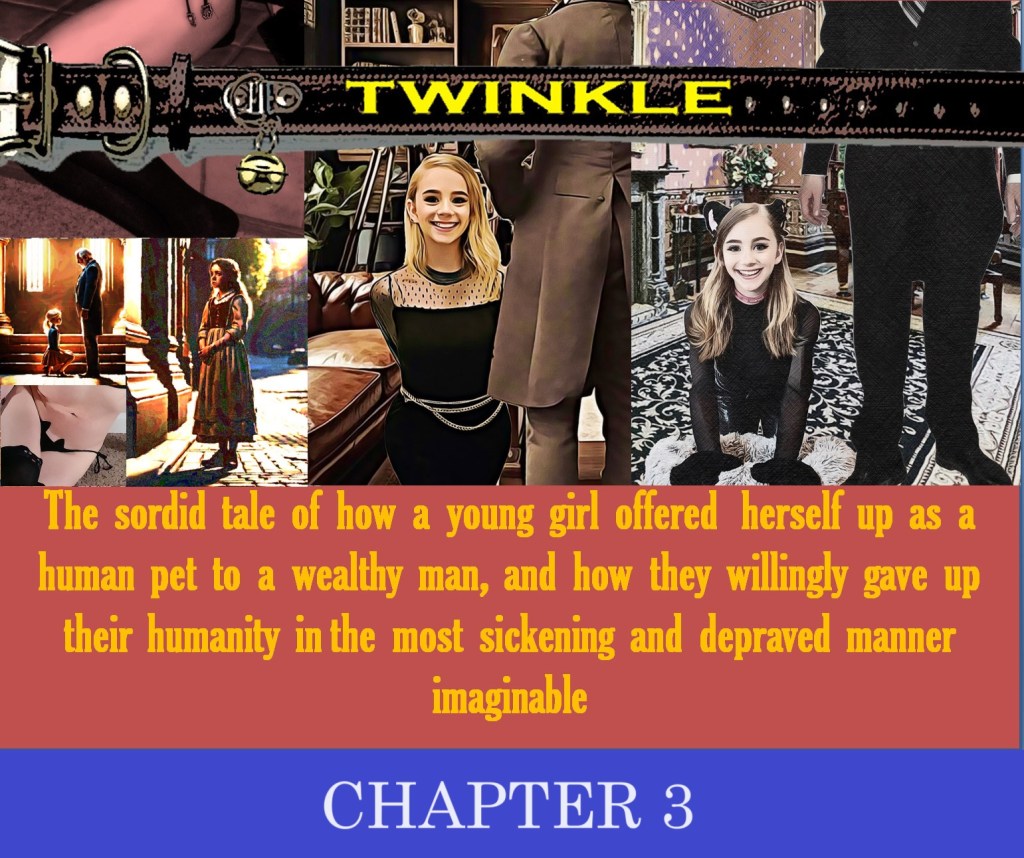
And I knew that today’s events would be talked about, and word would spread about the young girl who accepted a sordid agreement. A sordid agreement to eat food meant for an animal from a bowl on the floor in the center of a bank’s hall. And that she did this so as to keep going during the tribulations that had hit the nation. And about the rich banker who had been approached by this young girl and treated her desperation in such a sickening and depraved manner. Word would spread, and maybe even make it into the newspapers and record it for posterity. The sordid tale of the young girl who, in offering herself as a pet, regained some of her humanity, and the wealthy banker who, in how he responded to the offer, showed that he had lost some of his.

 Madison's Blog